The Shadow Fleet
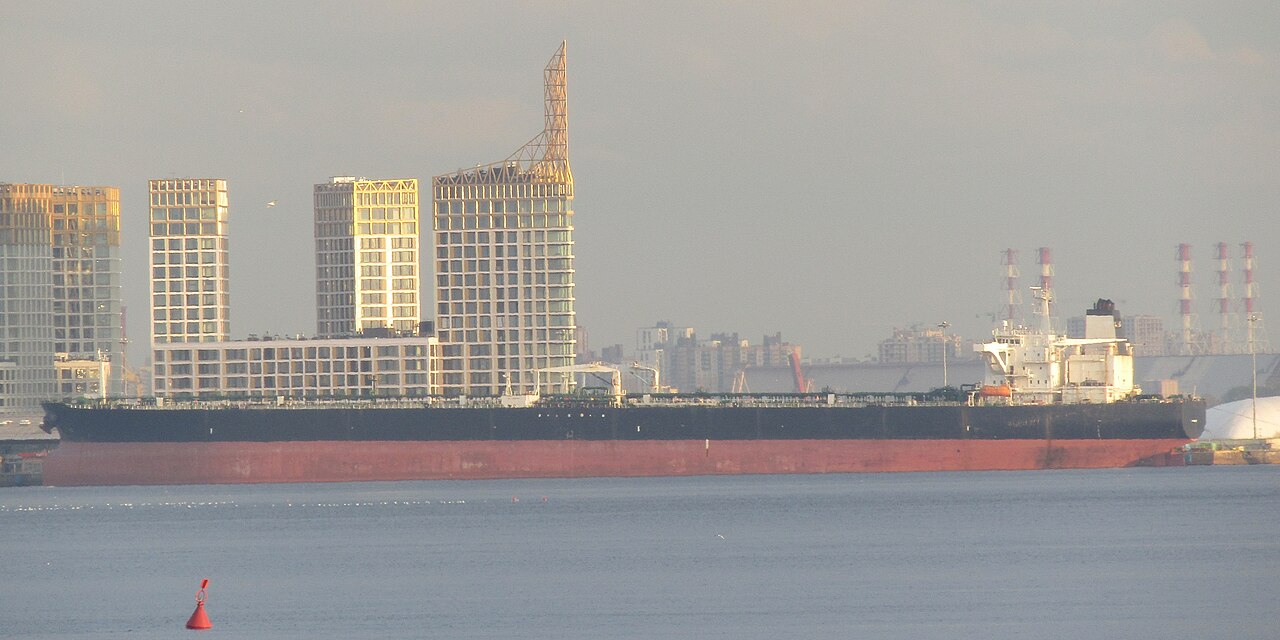
In March 2026, 129 tankers left Russian ports carrying crude oil. Eighty percent of them belonged to no legitimate maritime system. They flew flags of Cameroon, Sierra Leone, and Russia itself. They carried insurance from AlfaStrakhovanie and Sogaz instead of the international group that covers 90 percent of world tonnage. Their final destinations were unknown for more than a fifth of the volume.
These ships are the shadow fleet, and they carry 81 percent of Russia’s crude oil exports.
The number sounds like an evasion statistic, a footnote to sanctions policy. It is the scale of an alternative maritime order, built in three years under the most aggressive sanctions regime in modern history.
The Infrastructure of Evasion
A fleet needs more than ships. It needs flags, insurers, and registries willing to look the other way. The shadow fleet has all three. The architecture is hardening.
The KSE Institute tracks flag distributions monthly. In May 2025, 3 percent of shadow tankers flew the Russian flag. By March 2026, the number was 24 percent. The Panama flag, long the default for sanctions evaders, fell from 36 percent to 8 percent over the same period. The top three flags now covering shadow fleet volumes are Cameroon, Russia, and Sierra Leone, together accounting for 73 percent.
The shift is not random. AGILE-GISS published the first quantitative study of re-flagging patterns among sanctioned Russian vessels in June 2026. The researchers confirmed what maritime analytics companies had reported qualitatively: shadow fleet vessels are moving from classic flags of convenience (Liberia, the Marshall Islands, Malta) to a new cluster of registries with even less oversight. The paper calls them “flags of deceit.” Cameroon, Sierra Leone, Oman, Mozambique, Azerbaijan. These registries welcome older ships, often under fake identifiers. Africa is emerging as a major hub for re-flagging operations.
The age profile tells the same story. Ninety-three percent of shadow crude oil tankers are older than 15 years. These are ships that the legitimate maritime system has aged out of: too old for standard insurance, too risky for major ports, and the only tonnage willing to sail under these flags.
The insurance gap is the structural piece most coverage misses. The international P&I group, a consortium of insurers covering the vast majority of world tonnage, does not cover shadow tankers. Instead, they rely on Russian insurers: AlfaStrakhovanie, Sogaz, and Balance Insurance JSC. At least 30 tankers were operating under Russian insurance in April 2026. This is an alternative insurance architecture, built to underwrite a fleet that the existing system was designed to exclude.
The opacity is deliberate. Twenty-two percent of shadow crude oil volumes and 31 percent of oil product volumes have unknown final destinations. From Baltic Sea ports, the numbers are higher: 24 percent of crude and 37 percent of products vanish into undocumented supply chains. The shadow fleet moves oil into a space where the flag state, the insurer, and the destination port each hold only a partial picture of where it came from or where it is going.
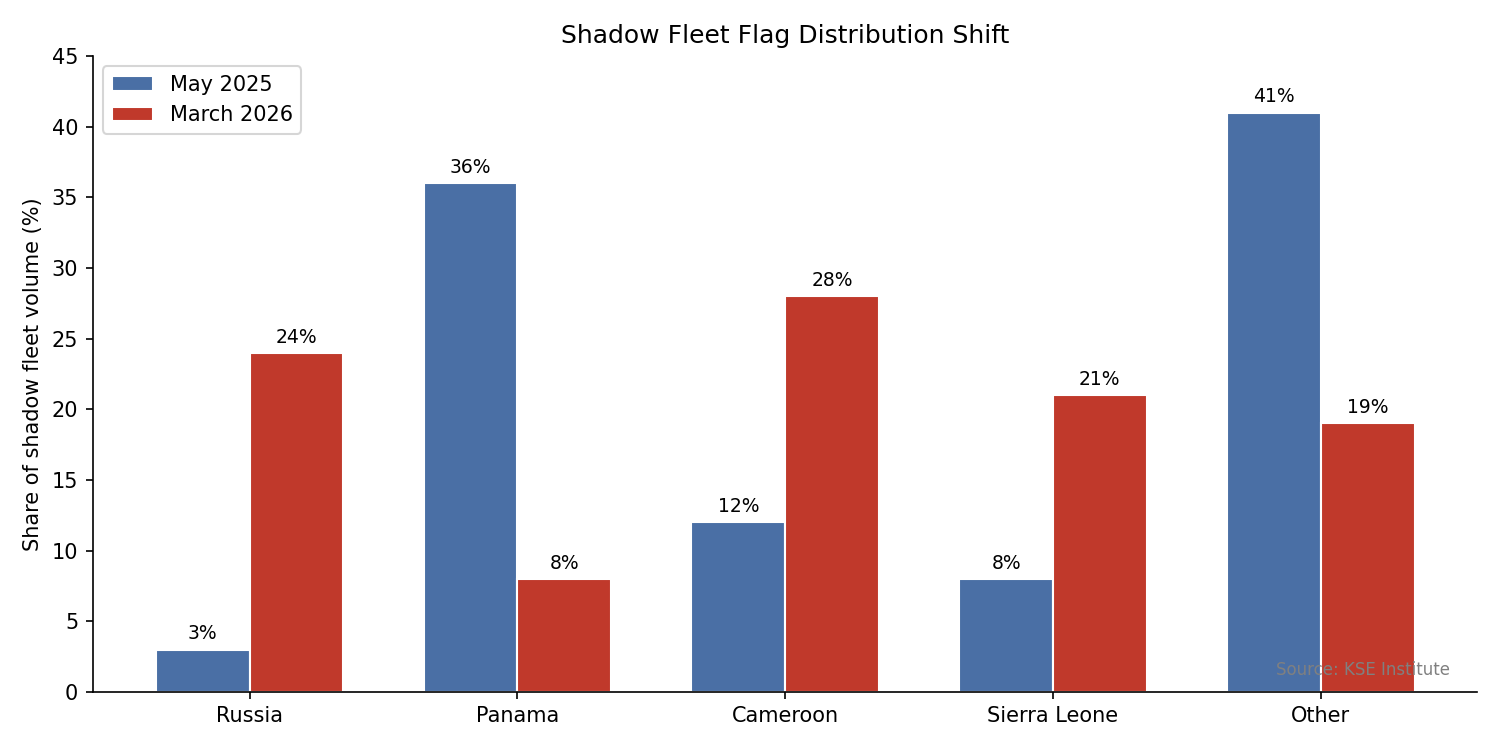
Shadow fleet flag distribution shift, May 2025 to March 2026. Russia’s flag share jumped from 3% to 24% while Panama fell from 36% to 8%. The top three flags (Cameroon, Russia, Sierra Leone) now cover 73% of volumes. Source: KSE Institute.
The Navy Behind the Fleet
For the first two and a half years of the shadow fleet’s existence, Russia denied any connection to it. That changed in early 2026.
The Atlantic Council describes the sequence. Estonia attempted to detain the shadow tanker Jaguar in the Baltic Sea. Russia responded with an Air Force intrusion into Estonian airspace. Since then, Russian military vessels have begun regularly escorting shadow fleet tankers through the Baltic Sea and the English Channel.
The escorts are a signal. Traditionally, navies escort merchant vessels through waters plagued by piracy or violence. The United States did it in the 1980s Tanker War, running Kuwaiti tankers through the Strait of Hormuz. Russia is doing the reverse: escorting vessels that violate maritime rules through the waters of coastal states that are trying to enforce those rules.
The Small Wars Journal reports that Russia’s Maritime Register of Shipping is preparing to re-register 80 to 120 tankers to the Russian flag. The legal logic is precise. UNCLOS Article 110 allows warships to board and inspect vessels operating without a valid national registry, the “without nationality” clause. By putting shadow tankers under the Russian flag, Russia removes the legal basis for boarding. Any future interdiction becomes a confrontation between a coast guard and a Russian-flagged vessel, with Russian military escorts nearby.
Some tankers are now being armed. Foreign Policy reported that shadow fleet vessels have been equipped with machine guns. An LNG tanker with a machine gun would have been, as one analyst put it, “virtually unimaginable” under any other flag. For coast guards accustomed to boarding unarmed merchant vessels, the prospect of boarding an armed, Russian-escorted, Russian-flagged tanker is a different proposition entirely.
The Coast Guards Push Back
The coastal states are pushing back. The Baltic Sea countries, France, India, and others have inspected and detained more shadow fleet vessels in 2026 than in prior years. Estonia, Finland, France, and Sweden have all boarded shadow vessels. The United Kingdom boarded its first Russian shadow tanker in the English Channel.
The enforcement is real, but it faces a structural problem. Every time a coast guard boards a shadow tanker, it is enforcing maritime rules against a vessel backed by a nuclear-armed state that has re-flagged its fleet specifically to make that boarding a diplomatic incident. The more Russia escorts, the riskier boarding becomes. The more Russia re-flags, the fewer legal grounds exist for boarding. The enforcement curve and the evasion curve are running in opposite directions.
The Case That Sanctions Work
None of this means sanctions have failed. The evidence that they bite is real.
The KSE Institute’s vessel designation impact assessment found that US sanctions caused a 74 percent drop in crude oil volumes transported by sanctioned vessels. Transport efficiency deteriorated by 45 to 57 percent: longer routes, more intermediaries, more ship-to-ship transfers. The system adapts, but it becomes dramatically less efficient.
EU sanctions produced a different pattern: a 50 percent volume decline with no subsequent rebound. Less immediately disruptive than US sanctions, but more structurally persistent. The trade reshapes itself around the constraints.
CREA estimates that Russia earned EUR 193 billion in fossil fuel export revenues in the fourth year of the Ukraine invasion, a 19 percent year-on-year drop and 27 percent below pre-invasion levels. Crude oil revenues fell 18 percent. The revenue cost is not hypothetical.
And the enforcement is escalating. In the fourth year of the invasion alone, 312 unique vessels were sanctioned, more than the 253 sanctioned in the first three years combined. The EU led with 397 designations, followed by the UK with 341.
The problem is that the shadow fleet adapts faster than the sanctions regime can designate. When the US sanctioned Rosneft and Lukoil, their seaborne crude exports dropped 83 percent. But new intermediary trading companies (RusExport and Redwood Global Supply Group) emerged to fill the gap, exporting 5.5 and 11.5 million tonnes respectively between December 2025 and February 2026. Non-sanctioned tankers compensated by transporting 27 percent more Russian oil per month. The total volume barely moved. The plumbing rerouted.
The Paradox
Here is what the sanctions built.
A fleet of aging tankers flying flags of deceit, insured by Russian companies, carrying oil into undocumented supply chains, escorted by Russian warships through the waters of the states trying to stop them, re-flagged to make boarding a diplomatic crisis, and in some cases armed.
In the narrow sense, sanctions are working. The revenue is down. The efficiency is down. The enforcement is up. But the pressure of the sanctions has created exactly the thing the rules-based maritime order was designed to prevent: a parallel system, self-contained and state-backed, operating outside the framework that has governed global shipping since the postwar settlement.
The rules-based maritime order depends on a shared assumption: flags mean something, insurance means something, and the waters between ports are governed by law rather than power. The shadow fleet violates those assumptions and has built an alternative that functions.
What the Fleet Is For
The immediate purpose is revenue. Russia needs to sell oil. The shadow fleet lets it sell oil.
The longer purpose is strategic. A fleet that flies Russian flags, carries Russian insurance, sails under Russian military escort, and cannot be legally boarded without risking a confrontation is a fleet that gives Russia power over the very maritime order it is accused of undermining. Every tanker that transits the English Channel under Russian military protection is a demonstration that freedom of navigation now operates on negotiated terms, not legal rights.
The question the shadow fleet raises is not whether sanctions work. They do, by any honest measure. The question is what happens when the response to sanctions is construction rather than capitulation: when the sanctioned state builds an alternative system that is durable, self-sustaining, and backed by military force.
Command of the sea was never won once and held forever. It is re-earned continuously. And it now has to be re-earned against a fleet that exists because the coalition that commands the sea built it, inadvertently, with the tools designed to destroy it.