The Load-Bearing Structure
The dedication page of The Jungle reads: “TO THE WORKINGMEN OF AMERICA.”
That was 1906. Upton Sinclair wrote the novel to expose what happened to a Lithuanian immigrant family in the Chicago stockyards. What he found, and what the book depicts in passages that still make you wince, was a system engineered so that no individual worker could protect himself.
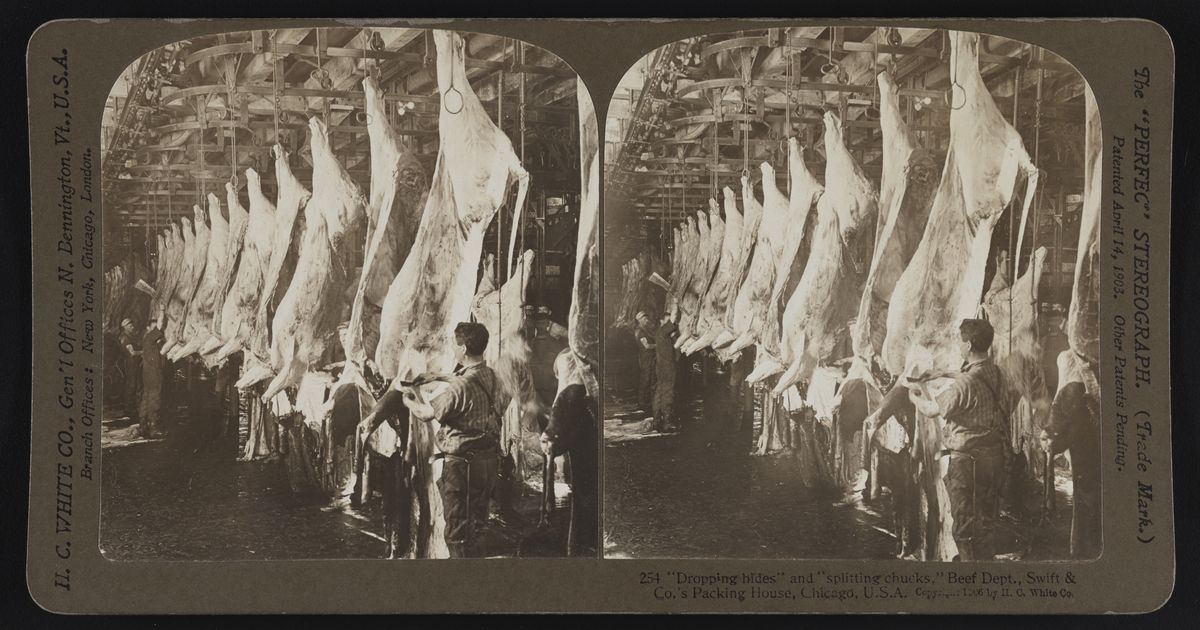
On the killing beds, the pace never let up. “From the instant the first steer fell till the sounding of the noon whistle, and again from half-past twelve till heaven only knew what hour in the late afternoon or evening, there was never one instant’s rest for a man, for his hand or his eye or his brain.” The companies hired pacemakers, men paid extra to set a brutal tempo, and rotated them frequently so the pace kept rising. “If any man could not keep up with the pace, there were hundreds outside begging to try.”
In winter the steam was so thick you couldn’t see five feet. Men’s hands went numb with cold, and they couldn’t wear gloves because they needed to grip knives. “It was to be counted as a wonder that there were not more men slaughtered than cattle.” In the pickle rooms the floor was never dry. Workers stood in cold brine all day. The filth scraped off the floor got shoveled back into the meat trucks. “Every few days it was the old man’s task to clean these out, and shovel their contents into one of the trucks with the rest of the meat!”
Sinclair’s protagonist, Jurgis, starts with the instinct every strong worker has: I’ll work harder. I’ll shift for myself. “If he gets the worst of it, there is nobody to listen to him holler.” That instinct is exactly what the packing houses counted on. The novel’s argument is simple: individual effort is futile against organized capital. “Their one chance for life was in union, and so the struggle became a kind of crusade.” The union was “a little state, the union, a miniature republic; its affairs were every man’s affairs, and every man had a real say about them.”
But even unions weren’t enough when the employers were organized too. “The employers were organized, also; and so the strikes generally failed, and as fast as the unions were broken up the men were coming over to the Socialists.” The book ends with a rallying cry that still echoes: “Organize! Organize! Organize!”
That was the problem 1906 identified. The question is what came next, and what came undone.
The Nordic Model: History, Not Miracle
The standard story about the Nordic countries goes like this: they’re small, homogeneous, blessed with oil (Norway) or cultural trust (Sweden), and their high taxes work because their people are just different. That story is wrong. The history is more interesting, and it matters because it tells us whether the model transfers.
Sweden’s industrial breakthrough in the late 19th century was largely spontaneous: individual companies, export-oriented, competing globally. Norway and Finland took a different path: the state played an active role mobilizing resources and managing natural endowments. Denmark combined agricultural cooperatives with a spontaneous small-business sector and a deliberate push for mass education. Four countries, four origin stories. What they share is what came after.
Juhana Vartiainen, writing for UNU-WIDER, describes it as a positive spiral: “Economic development has created the political demand for a welfare state , pensions, unemployment, and sickness insurance in particular , and the creation of welfare services has sustained the political popularity of further economic integration and technological progress.”
The key phrase is share the gains and losses. Restructuring creates losers: jobs disappear, firms die. Without a mechanism to compensate the losers, you get political resistance to technological progress and international openness. The Nordic solution was social insurance that mitigated those risks. “The four countries are quite similar in their acceptance of the market economy, technical progress and economic openness, coupled with a pursuit of equality and a state that has alleviated resistance to change by signalling a will to share the gains and losses due to structural change.”
So the welfare state wasn’t a moral luxury. It was the political technology that let a market economy keep innovating without generating a backlash that would shut the whole thing down.
The Mechanism: Wage Compression Fuels Creative Destruction
Here’s where it gets counterintuitive. Standard economics says compressed wages reduce incentives. The Nordic system does the opposite.
Barth, Moene, and Willumsen (2014) model the two-tier wage bargaining system: centralized tariff setting at the industry level, with constrained local wage drift. The compression does two things. First, it lowers expected wage costs for each vintage of capital investment, which raises expected profits and triggers more investment. More investment pushes up labor demand and equilibrium wages. Second, it forces creative destruction: resources shift from low-productivity to high-productivity firms because the wage floor makes marginal operations unviable.
“The puzzle is resolved once we account for the fact that lowering the expected wage costs leads to more creative destruction that moves a larger share of the work force to more productive enterprises. So even though the local bargaining power of work groups decline, they are moved to more productive vintages where even a lower bargaining power yields a higher average wage.”
The result: wage compression and higher average wages at the same time. That compression then fuels political support for welfare spending, which, critically, is not pure redistribution but a provider of social insurance, health care, and education. The whole thing is a flywheel.
Tax Levels: How They Sustain Rates That Would “Kill Growth” in the US
The numbers are stark. 2012 tax-to-GDP: Denmark 48.2%, Norway 42.8%, Sweden 45.8%. The US: 24.8%. Top marginal rates: 60–70% in Scandinavia versus 43% in the US. Participation tax rates, the effective tax on taking a job when you account for taxes, payroll, consumption taxes, and means-tested transfers, are around 80% in Scandinavia versus 36.6% in the US.
Henrik Kleven identifies three pillars that make this sustainable. One: thorough third-party information reporting, so evasion is low. Two: broad tax bases with limited deductions, so avoidance is low. Three: strong subsidization of goods complementary to working: childcare, eldercare, transport, education, which keeps labor force participation high.
The elasticity of taxable income is lower in Scandinavia because the base is broad. The US’s high elasticity is largely driven by the deductions and expenditures that narrow the base. So the very things that make US taxes “progressive” on paper , the maze of credits, carve-outs, and preferential rates , are what make high statutory rates unsustainable in practice.
Generalizability: The Opposing Case, Steelmanned
The objections are familiar. Lane Kenworthy catalogs them: immutable work ethic, superior intelligence, trust, solidarity, small population, racial homogeneity, institutional coherence, effective government, corporatist concertation, willingness to be taxed, tax compliance, strong unions.
He then tests each against data. PISA scores: Finland scores high, but Denmark, Norway, and Sweden are average or below. Work ethic: average hours worked are low in the Nordics, not high; Swedish sickness insurance got so generous (90% salary replacement) it reduced work effort. Small population and homogeneity: other small homogeneous countries (Singapore, Switzerland) don’t have the same outcomes, and the Nordics have become dramatically more diverse over 40 years while maintaining the model. Norway’s oil: the model predates oil, and Denmark, Sweden, and Finland achieved similar outcomes without it.
His conclusion: “Social democratic capitalism’s success very likely is generalizable. The successful outcomes we observe in the Nordic nations are likely to carry over to other countries that adopt social democratic capitalist policies.”
The obstacles are political, not economic.
The Era Conservatives Romanticize
Here’s a fact that gets lost: the 1950s and 1960s , the era US conservatives hold up as the golden age , had a top statutory corporate tax rate of 52% (1952–1963), plus a 30% excess profits tax in effect from July 1950 through 1953. The 1951 Revenue Act, passed to fund the Korean War, raised the top rate from 38% to 50.75% effective March 31, 1951. During the Vietnam War the top rate hit 52.8% (1965–1967, including a 10% surcharge) and 49.2% (1968–1969, with a 2.5% surcharge). It didn’t drop to 48% until 1970, then 46% (1975–1978), 40% (1979–1981), and finally 34% after the 1986 Tax Reform Act.
These are IRS Statistics of Income numbers. Official. Not a model. Not an estimate. The table is public.
And crucially: the methods for owners to extract wealth out of businesses were underdeveloped. No SEC Rule 10b-18 (that came in 1982). No safe harbor for open-market repurchases. No explosion of stock options as executive compensation. The corporate form still largely operated on retain-and-reinvest: the corporation retains earnings and reinvests them in the productive capabilities embodied in its labor force.
The Extraction Era
William Lazonick documents the transition. Over the past three decades, corporate resource allocation at major US firms shifted from retain-and-reinvest to downsize-and-distribute. Under the new model, the corporation lays off experienced, often more expensive workers and distributes corporate cash to shareholders.
The numbers are staggering. Take the 449 firms in the S&P 500 that were publicly listed from 2003 through 2012. They used 54% of their earnings , a total of $2.4 trillion , to buy back their own stock (stock buybacks: repurchases of a company’s own shares, reducing share count and boosting per-share price). Dividends absorbed an additional 37%. That’s 91% of net income flowing to shareholders.
For 248 large firms tracked over decades, buybacks were 2% of net income in 1981. By 2004–2013 they hit 47%. Total payout ratios (buybacks plus dividends) ran 79%, 79%, 84% by decade.
SEC Rule 10b-18, promulgated November 17, 1982, gave companies a safe harbor against manipulation charges for open-market repurchases. The buyback wave started the day the rule took effect.
Executive pay followed. In 2012 the 500 highest-paid executives averaged $24.4 million, with 52% from stock options and 26% from stock awards. The incentive structure aligned perfectly: boost the share price, cash out. This is the logic of shareholder-value ideology: the doctrine that a corporation’s primary purpose is to maximize shareholder returns, measured by stock price.
The wealth data tells the same story. Saez and Zucman (2016) show a U-shaped evolution of US wealth concentration. The top 0.1% share was around 25% in 1929, fell to 7% in 1978, and climbed back to 22% in 2012 , almost the 1929 peak. The bottom 90% share rose from ~20% in the 1920s to a high of 35% in the mid-1980s, then declined to ~23% by 2012. The top 10% share went from 84% (late 1920s) to 63% (mid-1980s) to 77.2% (2012).
“The rise of wealth inequality is almost entirely due to the rise of the top 0.1% wealth share, from 7% in 1979 to 22% in 2012.” Strikingly, “the average real wealth of the bottom 90% of families was no higher in 2012 than in 1986.” Twenty-six years. Zero real gains.
When Money Stops Circulating
Velocity of money , GDP divided by money supply , is the most underrated macroeconomic indicator. It measures how fast a dollar changes hands. When velocity falls, the same money stock supports less economic activity.
FRED data (Federal Reserve Bank of St. Louis): M2 velocity peaked at 2.192 in July 1997. By Q2 2026 it was 1.412. A 36% decline. In the 1960s it ranged roughly 1.65–1.82.
Why does velocity fall when income concentrates? The marginal propensity to consume (MPC). Karger and Rajan (Chicago Fed, 2020) studied stimulus payments to one million households. Households living paycheck-to-paycheck spent 60% of the payment within two weeks. High-liquidity households , the ones who save much of their income , spent 24%.
MPC of 0.60 versus 0.24. That’s a 2.5x difference.
When the bottom 90% stop gaining wealth, the households with the highest MPC get a shrinking share of income. The dollars accumulate at the top where they’re saved, not spent. Velocity drops. The economy becomes less elastic: less able to absorb shocks, less able to sustain demand without artificial stimulus.
Markets That Don’t Self-Regulate
Lina Khan’s “Amazon’s Antitrust Paradox” (Yale Law Journal, 2017) makes the case that the current framework is blind to the harms that matter in platform economies.
The framework pegs competition to “consumer welfare” defined as short-term price effects. That lens misses predatory pricing (which looks like low prices) and vertical integration (which looks like efficiency). But platform economics make predatory pricing rational: growth over profits, rewarded by investors, and integration lets platforms control the infrastructure their rivals depend on while exploiting data from those same rivals.
“We cannot cognize the potential harms to competition posed by Amazon’s dominance if we measure competition primarily through price and output. Specifically, current doctrine underappreciates the risk of predatory pricing and how integration across distinct business lines may prove anticompetitive.”
The opposing case, from Robert Bork’s The Antitrust Paradox (1978): the sole normative objective should be consumer welfare via economic efficiency; firms with market power can’t maintain high prices if entry is free; market power is fleeting; antitrust enforcement rarely needed. “With so many entry barriers discounted, all firms are subject to the threat of potential competition… regardless of the number of firms or levels of concentration.”
That was the doctrine that carried the day for 40 years. It’s the reason the FTC and DOJ watched the platform monopolies form and did nothing.
The Counterargument: The Strongest Objections
Three objections deserve serious engagement.
Milton Friedman (Capitalism and Freedom, 1962): “Nobody spends somebody else’s money as carefully as he spends his own.” Government spending is inherently inefficient because it spends other people’s money on other people , no cost consciousness, no quality consciousness. The proper role of government is limited to defining, arbitrating, and enforcing the rules of the game: contract enforcement, property rights, national defense. Redistribution is coercive; voluntary exchange through competitive capitalism coordinates complex social activity without coercion. Spontaneous order. Prices as information. Central planning is unnecessary and dangerous to freedom.
Alesina, Glaeser, and Sacerdote (2001): Why doesn’t the US have a European-style welfare state? Economic explanations , income variance, skewness, deadweight loss, volatility, mobility , don’t explain the gap. Racial heterogeneity does. “Racial animosity in the US makes redistribution to the poor, who are disproportionately black, unappealing to many voters.” Across countries, racial fragmentation predicts redistribution. Within the US, race is the single most important predictor of welfare support. US political institutions , no proportional representation, strong courts, federalism , structurally limit redistribution by constraining the political power of the poor.
Robert Bork (1978): The consumer-welfare standard justifies lenient antitrust. Aggressive enforcement against vertical restraints and predatory pricing protects inefficient competitors, not competition. Market power is always fleeting; entry is the real discipline.
These are not strawmen. They are the intellectual architecture of the opposition.
The Rebuttals
Friedman’s “nobody spends other people’s money carefully” assumes government inefficiency is intrinsic. But Alesina et al. show US government spending is lower than Europe’s, not less efficient per dollar. And the reciprocal altruism Friedman praises , voluntary exchange , breaks down under the racial heterogeneity Alesina documents. The mechanism Friedman trusts to coordinate society is the very mechanism Alesina shows fails in heterogeneous societies.
Alesina et al.’s own findings contain the seeds of the rebuttal. Racial fragmentation operates through beliefs , “the poor are lazy” versus “the poor are unlucky.” Beliefs can change. Universal programs (Social Security, Medicare) enjoy broad support across racial lines, suggesting program design can overcome the cleavage. The paper also admits “some possibility that middle-class households in the US have a greater chance of moving up… which would make the median voter more averse to redistribution.” That is an economic factor , mobility expectations , they can’t rule out.
Bork’s consumer-welfare standard has been empirically falsified in concentrated industries. Post-Chicago literature shows vertical mergers can raise rivals’ costs; predatory pricing can be profitable; the one-monopoly-rent theory is flawed. Levenstein and Suslow (2014) found that one-quarter of modern cartels used vertical restraints to sustain collusion , exactly the practices Bork presumed were “welfare enhancing.” Bork also offered no alternative for detecting exclusionary conduct that does harm consumers in digital markets: exclusive dealing, self-preferencing, data exploitation.
Economic Elasticity Is Built from the Bottom Up
The threads connect.
The Jungle showed that individual workers cannot protect themselves against organized capital. The Nordic model institutionalized the solution: a deal to share the gains and losses of structural change. That deal produced wage compression, which fueled creative destruction and higher average wages, which generated political support for the welfare state , not as charity, but as social insurance that keeps the flywheel spinning.
The era conservatives romanticize had high corporate tax rates and no extraction machinery. SEC Rule 10b-18 (1982) enabled the buyback wave. The shift from retain-and-reinvest to downsize-and-distribute sent 91% of S&P 500 net income to shareholders. The top 0.1% captured almost all wealth gains since 1978. The bottom 90% gained zero real wealth in 26 years.
Concentration hoards money at the top where MPC is 0.24. Velocity collapsed from 2.19 to 1.41. Antitrust’s price-only lens missed the platform monopolies that grew by design, not by accident.
The counterarguments are real. Friedman is right that incentives matter. Alesina is right that heterogeneity undermines solidarity. Bork is right that bad antitrust enforcement protects competitors, not competition.
But the Nordic countries proved the heterogeneity obstacle is political, not fatal. They proved high taxes with broad bases and work-complementary subsidies are sustainable. They proved wage compression drives innovation, not stagnation. Kenworthy’s generalizability claim stands: the successful outcomes carry over to countries that adopt the policies , once the political impediments are surmounted.
Economic elasticity — the capacity to absorb shocks, innovate, and endure — comes from protecting the people who produce the value, not from geography or luck.
Social democracy is the load-bearing structure of long-run economic endurance, not a moral luxury.