A World at War Is Fusing at Sea
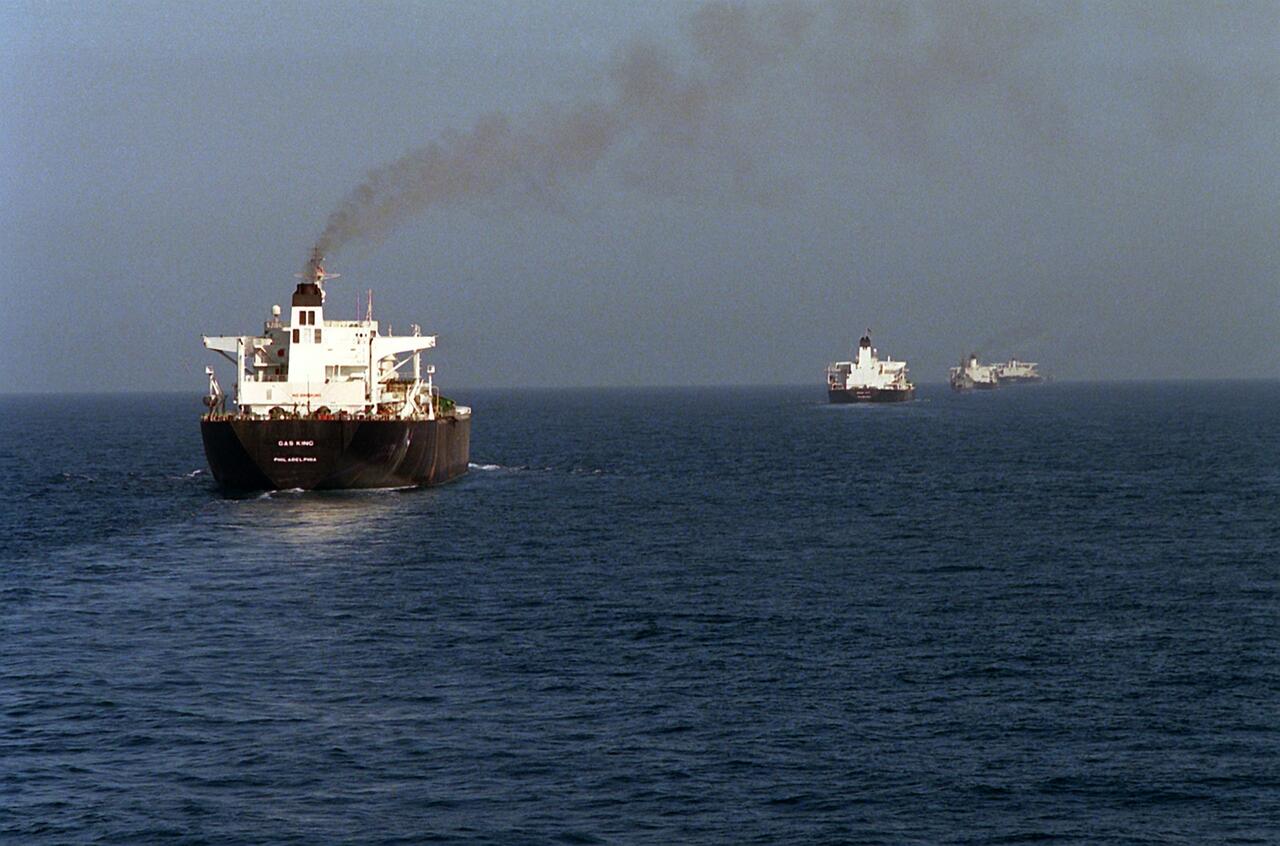
The wars in Ukraine and the Gulf are nominally separate conflicts. A Ukrainian drone strike on the Caspian in late July 2026 showed the pretense eroding.
RFE/RL reported the targets as the Molnyia and the Port Olya 2 and Begey, vessels Kyiv’s intelligence service described as ferrying military cargo between Iran and Russia. Tehran said one sailor was killed and summoned Ukraine’s chargé d’affaires; Foreign Minister Abbas Araqchi called it “a blatant United Nations Charter violation.”
Notice what is strange about that sentence. Ukraine is at war with Russia. The targets it hit belonged, in part, to Iran. A Ukrainian attack fell on Iranian shipping in a landlocked sea thousands of kilometers from the front line. In the middle of its own war, Ukraine landed in the middle of someone else’s.
The two wars are the Russia-Ukraine war and the 2026 United States campaign against Iran. Washington has tried to keep them separate. Ukraine just demonstrated how hard that is getting. These are not two wars that happen to be running in parallel. They are one conflict system, and the joint is the maritime commons: the open ocean and the shipping lanes that cross it.
The War Beneath the War
The partnership that fused them predates the current fighting. Since the full-scale invasion of Ukraine in February 2022, Russia and Iran have deepened their defense and economic cooperation; RAND analysts describe Iran’s shift from a client to a supplier state. The visible face of that shift was the drone economy. Iranian-designed Shahed drones arrived in Russia in their thousands and were used extensively against Ukraine.
The flow runs the other way too. As Russia-Iran analyst Nicole Grajewski describes it, Moscow has returned the favor with satellite imagery, “potentially targeting support,” and data sharing meant to help Iranian strikes against US facilities in the Gulf. All of it sits under a deliberate veneer of plausible deniability. Each link is deniable on its own. Together they form a war beneath the war.
Ukraine now works the other side of that same drone economy. That shift began in March 2026, when Kyiv sent military personnel whose specialty is downing Shahed drones to Gulf states under sustained Iranian air attack; the Institute for the Study of War reported that three Gulf states sought to buy Ukrainian interceptor drones. Zelensky said more than 200 Ukrainian air-defense experts had been sent to the region, and RFE/RL reported a Gulf tour that ended in defense cooperation agreements. The drone Iran supplies Russia to fly over Ukrainian cities is the drone Iran flies at the Gulf, and Ukraine now helps shoot it down over both.
The Caspian Sea is where that hidden war became visible. Russia’s 28-ship flotilla, based at Makhachkala, has fired missiles into Ukraine from the same water Israel’s jets struck at Bandar Anzali in March 2026, and that now hosts Ukrainian drones hunting Iranian-linked cargo. A body of water most strategic commentary treats as a backwater has become a contact line between wars.
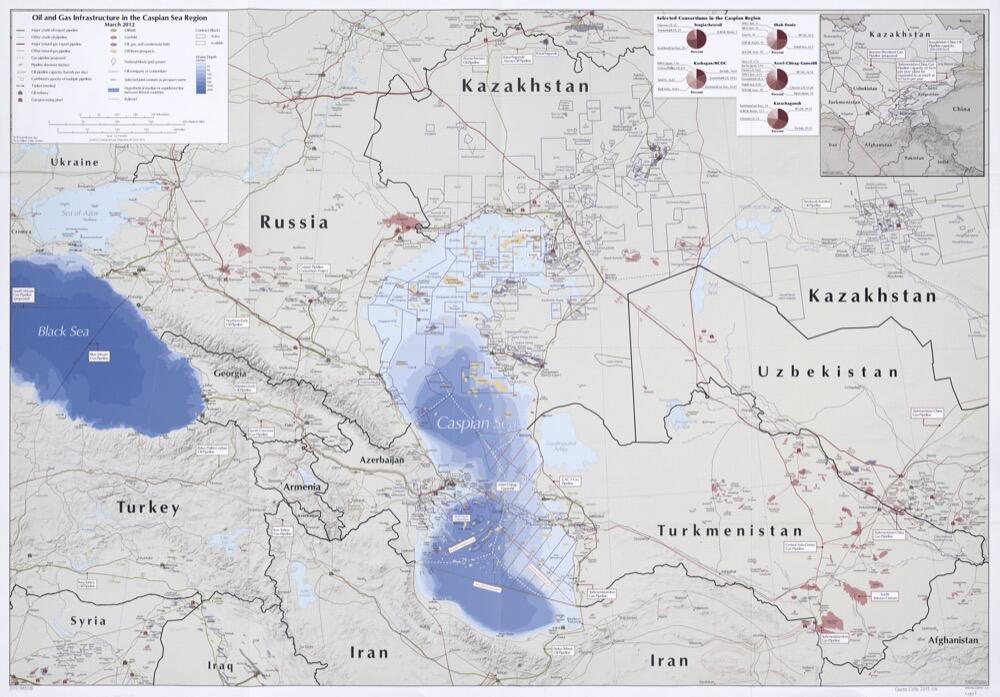
The Caspian basin’s oil and gas infrastructure, mapped by the CIA in 2012. The war beneath the war runs along these pipelines. Map: U.S. Central Intelligence Agency (public domain), via Library of Congress / Wikimedia Commons.
The Commons as the Junction
The mechanics are older than any single front. The Royal United Services Institute describes a mode of coercion in which individually modest, deniable acts accumulate into a shift of strategic reality without ever crossing the threshold that would justify a decisive response. A patrol here, a withheld licence there, a ship struck without a declared belligerent. Applied to Russia and Iran, the same logic lets each country support the other’s war while insisting it has no part in that war at all.
Bargaining theory explains why separate disputes connect. William Spaniel’s work on alliance formation shows that states can be driven into costly conflict with a rival of the power whose alliance they want: fighting someone else’s enemy is a way of buying someone’s loyalty. A Ukrainian drone over the Caspian is an act of war against Iran, and also a message of reliability to the coalition Iran is fighting. One strike, two wars, one sea.
The pattern extends beyond the Caspian. In the Red Sea, the Houthi blockade of Saudi ports, imposed on July 20, 2026, has forced at least seven vessels to divert from the Bab el-Mandeb strait, and the Institute for the Study of War and Critical Threats Project tracked attacks on two Saudi oil tankers two days later. The commons is the junction precisely because it is shared: land powers that cannot win on the open ocean attack the water itself.
The Case for Skepticism
Interweaving is only one direction of travel. RAND analysts have long argued that the postwar order is eroding without an alternative on offer, and that fragmentation, regional orders decoupling into separate systems, is the visible trend. On that reading, the Caspian collision is an exception at the seams: two wars brushing against each other, not one connected conflict.
The second objection is that “one war” overstates the coherence. Washington actively compartmentalizes, refusing to concede Russian involvement in the Gulf campaign. Iran’s own options are limited; as one former White House official put it, Tehran’s “bark is bigger than its bite” in this fight. Two wars may touch for a moment and move apart.
The Water Carries Everyone’s War
The skeptical case deserves its weight. But it misreads what the collision signals. Geographic access to the global commons has always been the primary determinant of great-power longevity. That logic cuts both ways. If the commons is what keeps maritime coalitions alive, then it is also the most efficient place to attack them: not by winning a sea battle, but by making the water itself unusable.
That is what the two wars have converged on. The drone supply line and the satellite targeting support, the blockade at Bab el-Mandeb, the Ukrainian drones over a sea they never needed to control before: these are the same war fought through the world’s shipping lanes.
Command of the sea was never won once and held forever. It is re-earned continuously, and it now has to be re-earned on water that carries everyone’s war. Whether these conflicts will fuse is no longer the question. The question is whether the coalitions that depend on open water are ready to pay the price of keeping it open.